

Broomsedge Golf Club
If you haven’t been paying attention, South Carolina has quickly become a state flourishing with worthy golf development, and a standout among the recent openings in the Palmetto State is Broomsedge Golf Club (pronounced Broom-sedge, not Brooms-edge).
Located in Rembert, South Carolina in the Sandhills region of the Palmetto State, just 30 minutes east of Columbia, Broomsedge was the vision of Mike Koprowski, who discovered the property in 2021. He was so sure of the land’s potential for golf that he purchased it himself without any investors on board. As a golf architecture enthusiast, Koprowski was living the dream, embarking on a project as both developer and golf course designer.
Broomsedge Golf Club
A closer look at the course
Koprowski took on the dual role of this minimalist inland links course along with architect veteran Kyle Franz (whose recent projects include renovations at Southern Pines, and Cabot Citrus). Franz served as the mentor, and together they were inspired to create a layout that evoked the feel of Golden Age golf – with a nod in the direction of Ross and Maxwell designs in the Carolinas.
The course opened for some preview play in late 2024/early 2025 to praise from raters and golf journalists, but Koprowski struggled to gather the necessary resources to take the club’s amenities and infrastructure to where he had envisioned. The overall development had stalled, and on-site lodging projects never got off the ground.
Enter 2026, and Baker Thompson takes over as the new CEO and Managing Partner of Broomsedge, ending the Koprowski era. Thompson had been part of the business and project development at Sand Valley with Michael Keiser and the Sandborn company (formerly Dream Golf). Thompson’s objective at Broomsedge is to finish the macro-vision of what Broomsedge can be. The big project will be 20 four-bedroom cottages, a restaurant, and clubhouse. During our visit last month, there was mention of a second golf course project, perhaps a putting or short course as well – positioning Broomsedge on its way to becoming a world-class golf destination.
What sets Thompson apart from others in the industry is his vision. He showed this at the Lido (Sand Valley), where he introduced the member club model with a welcoming UK ethos of public-access play (like many of the top clubs in Great Britain and Ireland). As the first-ever Captain at the Lido, Thompson curated member events and an “open door” culture that many clubs in the U.S. have shied away from, despite the many benefits that come from offering a level of inclusion.
“We created a fantastic place for the members (at Lido), but we also have public play five or six days a week,” Thompson said. “Here at Broomsedge, Michael (Keiser) insisted this needs a real estate piece, which is cottages and a great restaurant. Those are all things I learned from Sand Valley on the development side, master planning… making sure that the real estate and economics make sense.”
Broomsedge Golf Club
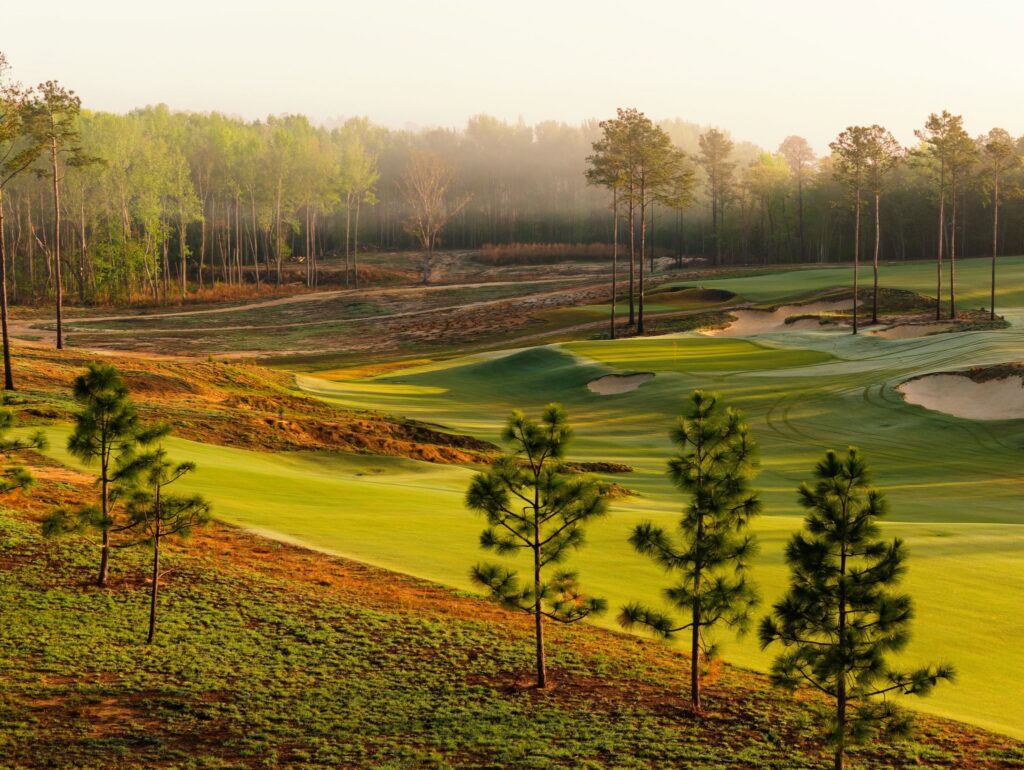
The 235-acre site features unusually dramatic elevation changes for the Carolina Sandhills area – which produced some unique natural landforms. This allowed Franz and Koprowski to create with a minimum amount of earth moved.
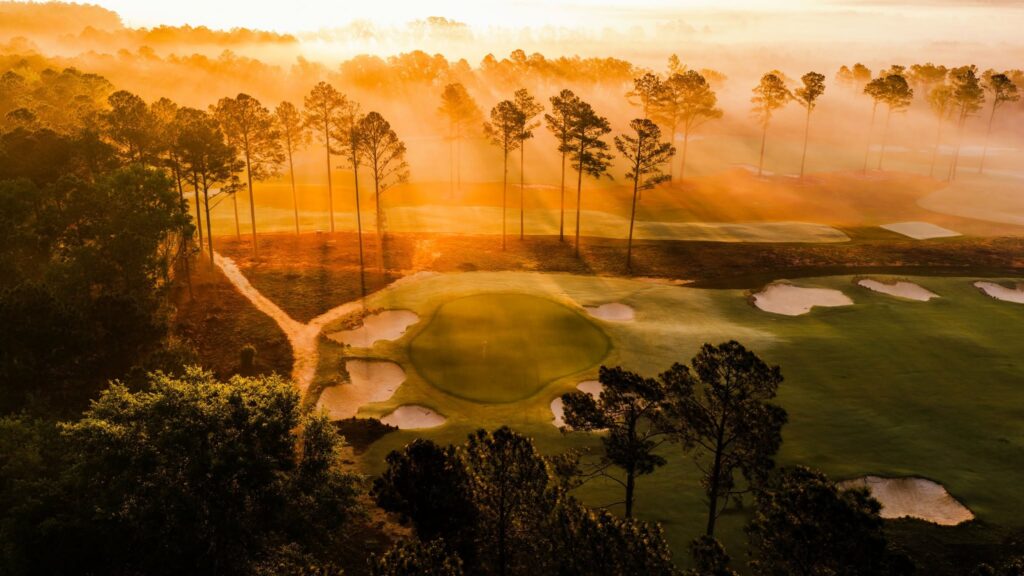
An instant classic par-3 here at the 11th, just a shorty – no more than a gap or pitching wedge to this green that sits benched perfectly into the hillside of Carolina Pines. It’s the shortest hole on the golf course, but miss this surface, and it’ll be easy to walkaway with five here.
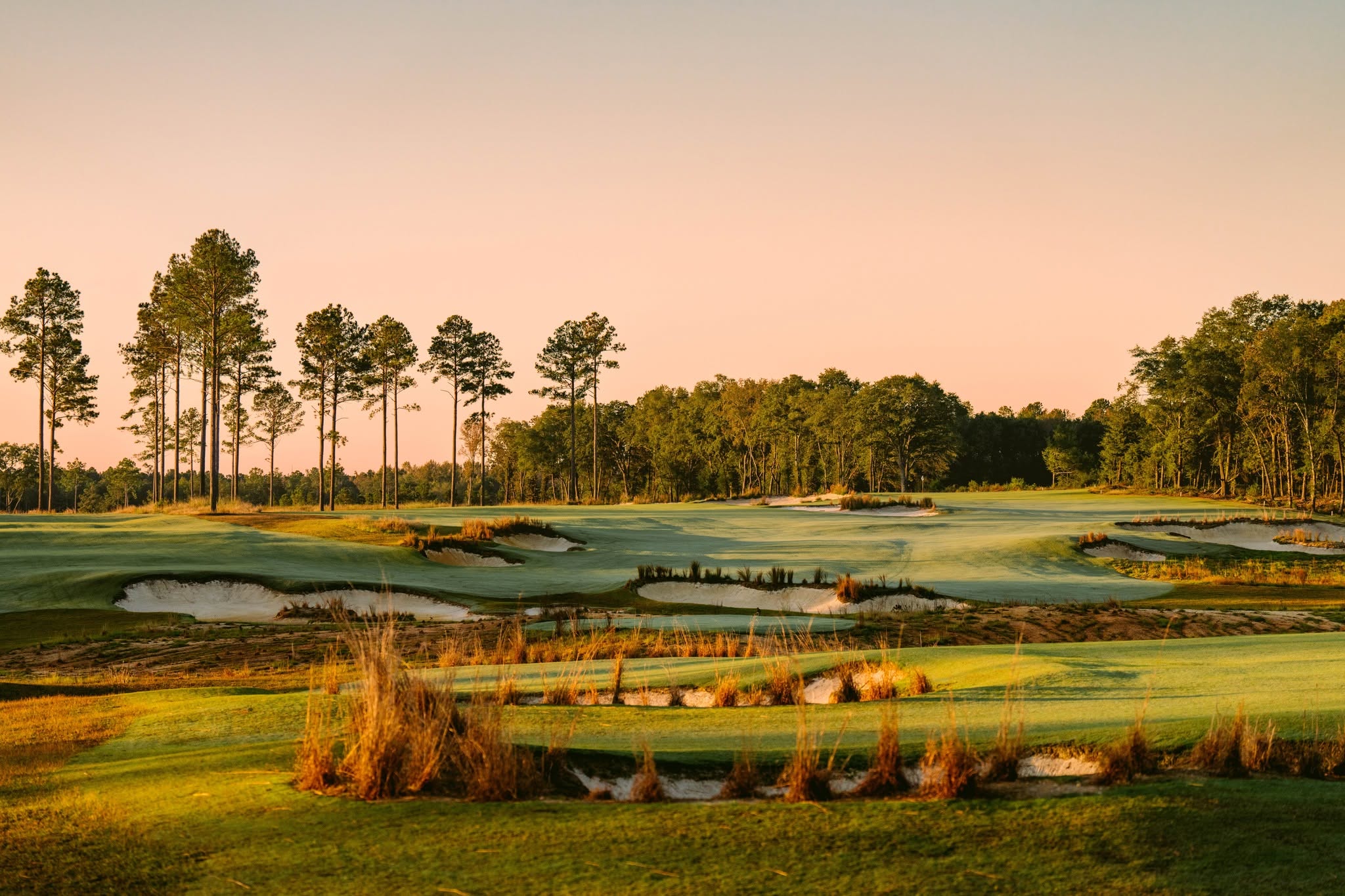
The course is predominantly one height cut from tee to green, but there are some holes where the tall and wispy native grasses border the fairways.
Some of the design principles that Koprowski and Franz sought to adhere to:
- Incorporation of property boundaries into lines of play; this is reminiscent of the Old Course at St. Andrews and other classic designs.
- Putting surfaces with classic contouring that ties into the surrounding topography
- Preservation of shot values off the tee, while still providing enough width to maintain the fundamental importance of angles to strategic design.
- Several holes that may change par from day-to-day depending on tee locations and weather conditions
- 20 green sites for 18 holes, allowing for setup flexibility
The short par-4 13th features a semi-blind approach to a greensite perched atop a giant hill featuring a myriad of bunkers. It’s a dazzling visual, but severely penal for those who misfire… uphill approaches often lead to short misses, but local knowledge – long leaves a relatively uncluttered chance to recover.
“As new builds have been increasingly focused on maximizing size and scale, ours is a departure from this trend,” said Koprowski. “For example, from the first tee players will be able to see no fewer than 15 different green sites. We’re creating something a bit more scaled down than what’s currently popular in golf design, and reflective of how courses were conceived and routed 100 years ago.”
The uphill 15th presents a choice and a decision that must be made from the teeing area. Dual fairways — and depending on wind direction, the green may be drivable for the longest players, but for mortals it’s a choice of which route suits you best. The left side is a shorter carry and is safer, but leaves a very challenging angle that’s semi-blind over a swale and deep sand with the greensite running away from you. Conversely, the right offers all of the risk/reward – carry the deep fairway bunker, which leaves a clear path and visual to any hole location, but this path also brings in a property boundary (OB further right). Strategically, it may be the best example of how to make a short 280/300 yard par 4 an enticing dilemma.
The golf course finishes with a brutally tough par-4 at the 17th, followed by a very gettable par-5 finisher.
An adequate drive into the super generous landing zone on 18 leaves somewhere from 215-240 yards in, depending on hole location. There’s a bail out right of the green where the only thing between you and a closing birdie is a chip and a putt. The Broomsedge grasses popping out above the bunker faces add to the visual and are reminiscent of the Scotch broom that lines the great bunkers of Merion.
Look for stay-and-play cottages coming soon, for more info on playing Broomsedge, click here.